How to Share an Outlook Calendar - The Complete 2026 Guide
- Published on
Table of Contents
Keep Your Calendars in Sync, Not Just Shared
Sharing an Outlook calendar lets your coworkers, family, or clients see when you are busy and what you have planned. In this guide, we will show you every way to share an Outlook calendar. We cover the new Outlook for Windows, classic Outlook on the desktop, and Outlook on the web. We also explain the permission levels, how to share with people outside your company, how to create a shared calendar, and how to stop sharing.
Outlook works a little differently depending on whether you have a work or school account (Microsoft 365) or a personal account (Outlook.com). We will point out those differences as we go.
Sharing vs syncing an Outlook calendar
Before we start, it helps to clear up a common mix-up, because it decides which method you actually need.
Sharing an Outlook calendar gives other people permission to look at your calendar. The events still live on your calendar, and the other person is simply viewing it. You decide whether they see only your free and busy times, the full event details, or whether they can also make changes.
Syncing two calendars is different. It copies events between calendars, so the same events appear on both. This is what you need if you want your Outlook events to show up on your Google or personal calendar, or if you want to combine two accounts into one view.
Outlook has a built-in sharing feature, which is what this article explains. It does not sync calendars. If syncing is what you are after, read our guide on how to sync two Outlook calendars.
Now let us share your Outlook calendar.
How to share an Outlook calendar in new Outlook for Windows
The new Outlook for Windows and Outlook on the web work almost the same way. Here is how to share your calendar with a specific person.
1. Open the Calendar
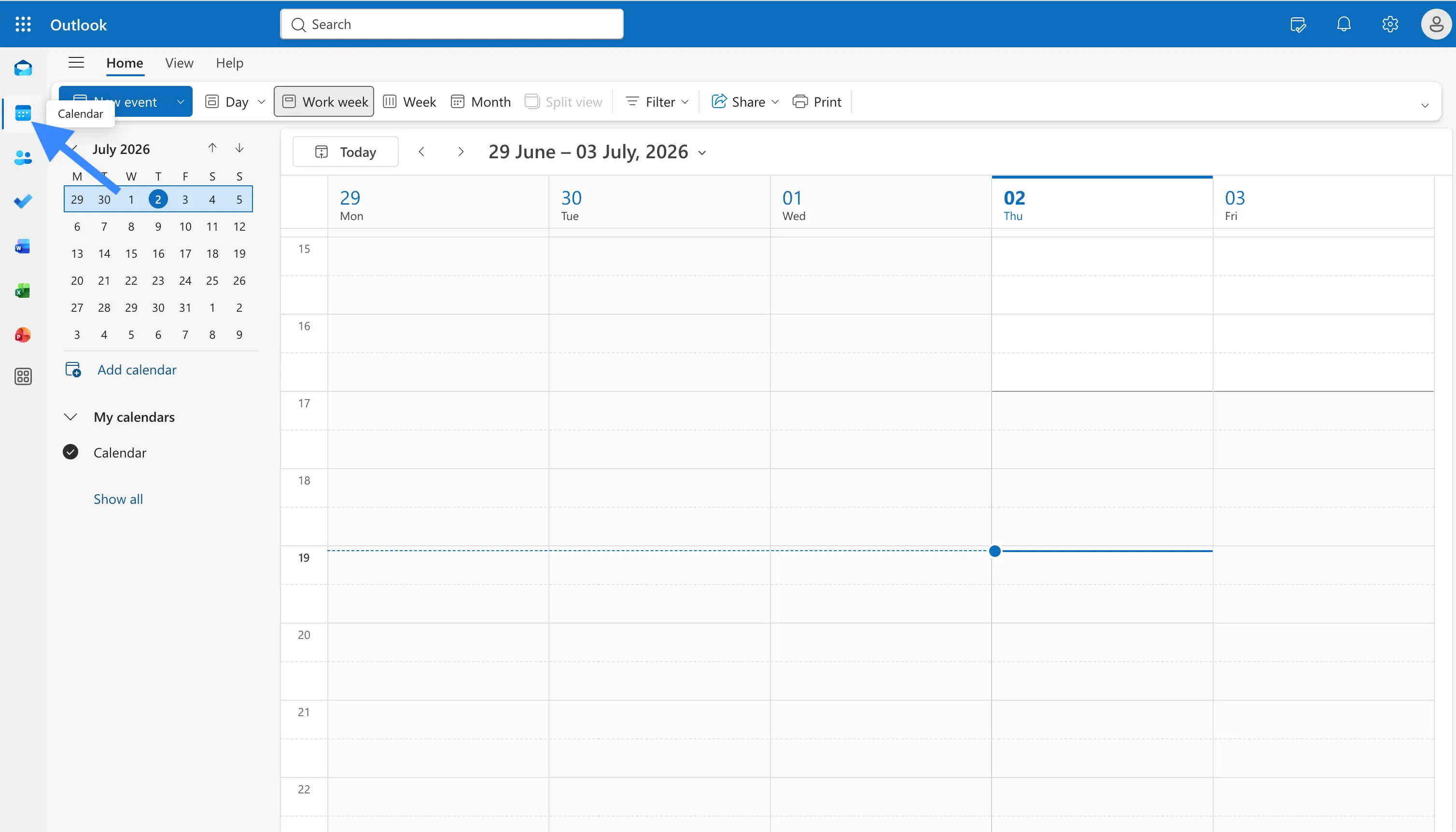
Open Outlook and click the Calendar icon in the left sidebar.
2. Open the Share menu
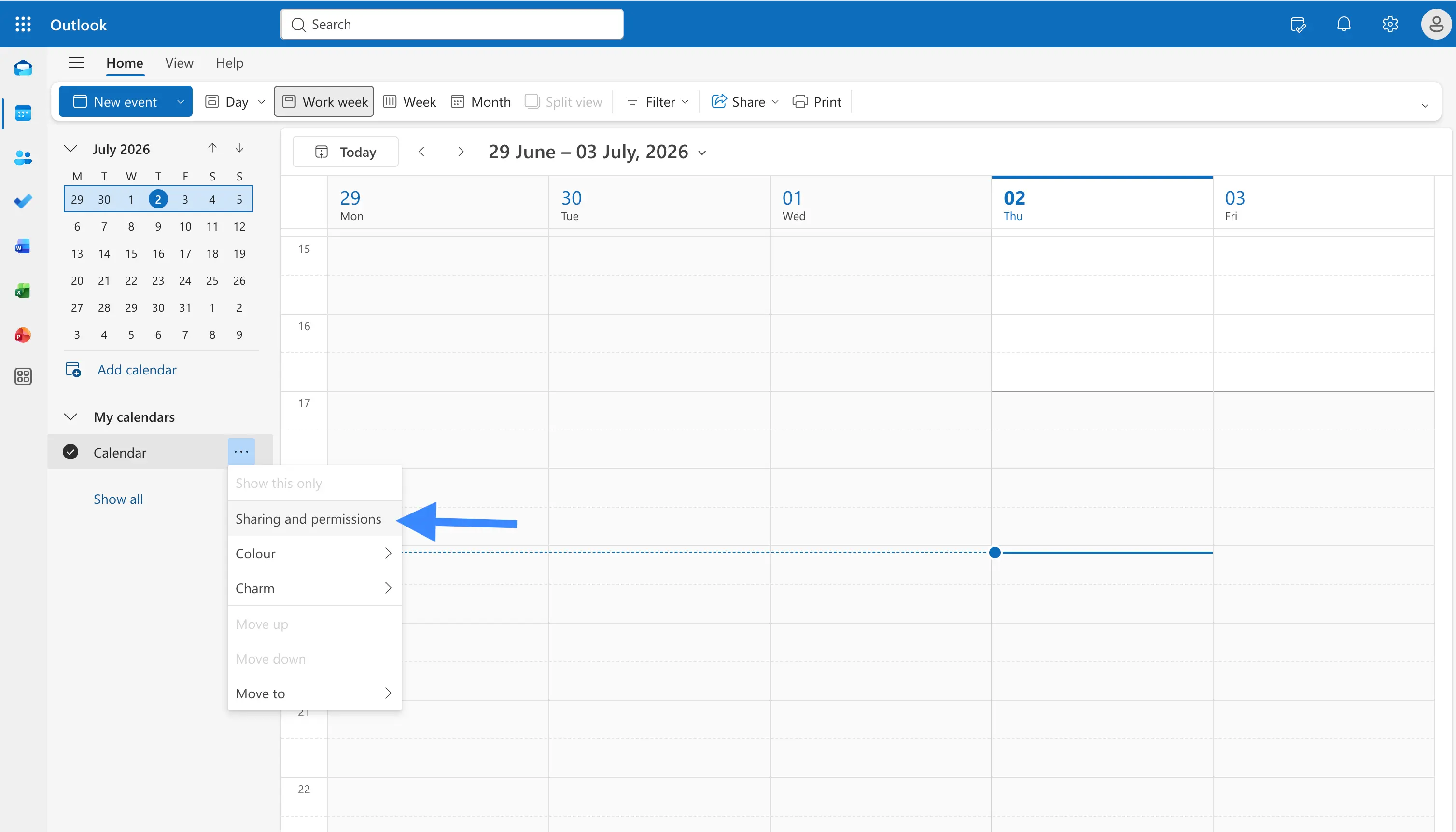
In the calendar list on the left, hover over the calendar you want to share. Click the three-dot More options menu and choose Sharing and permissions. You can also click the Share button in the toolbar at the top.
3. Enter the person's email address
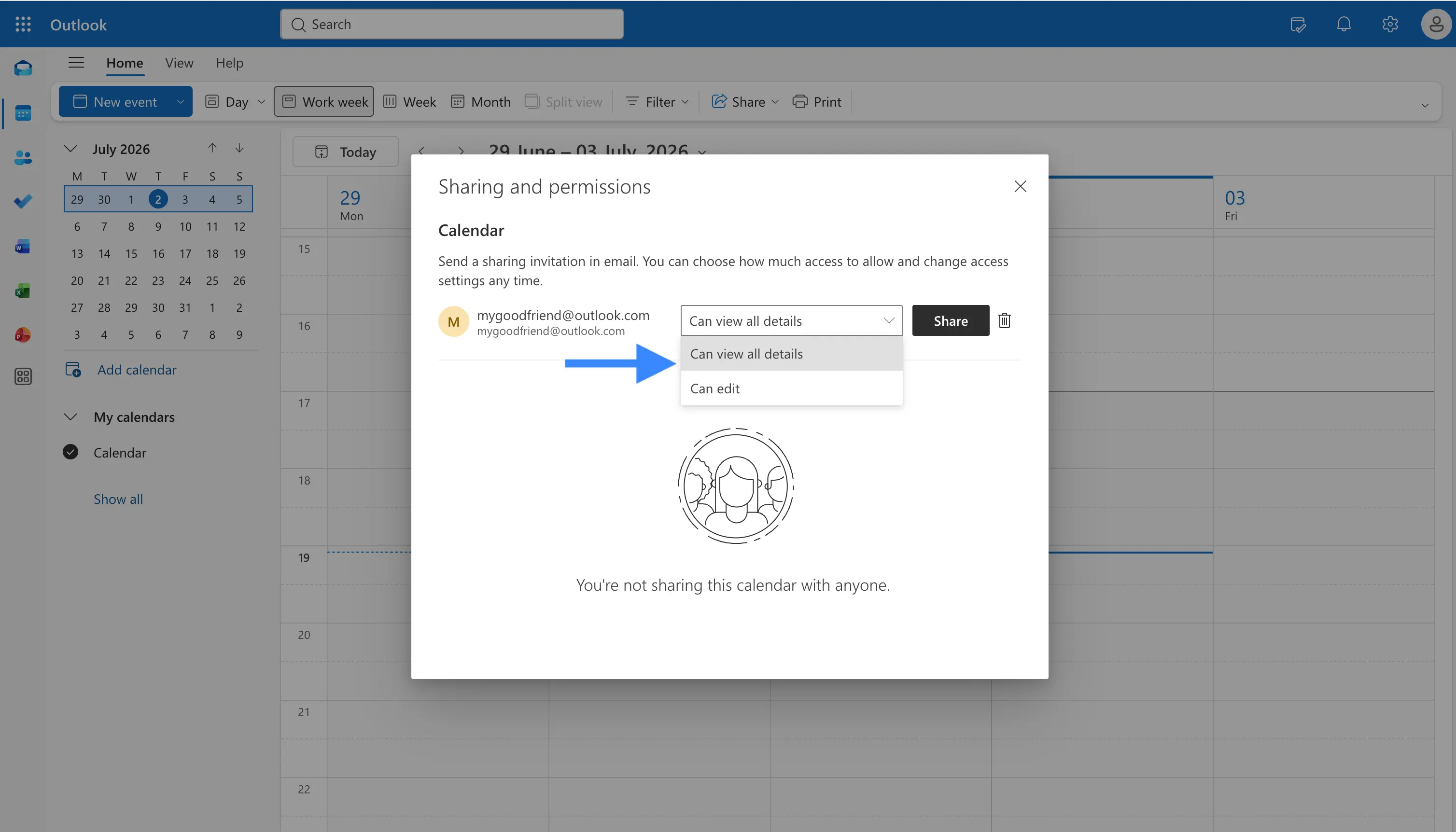
In the Sharing and permissions window, type the email address of the person you want to share with, then press Enter.
4. Choose a permission level and send
Pick a permission level from the dropdown next to their name. The next section explains what each level means. Click Share to send the invitation.
The person receives an email invitation. Once they accept it, your calendar appears in their list of calendars, and they see it based on the permission you gave them.
Direct sharing like this works best when the other person also uses Outlook or Microsoft 365. If you want to share with someone who uses Google Calendar, Apple Calendar, or no Microsoft account at all, the cleaner option is to publish your calendar as a link (covered further down in this guide).
Outlook calendar permission levels explained
When you share an Outlook calendar, you choose how much the other person can see or do. The exact names depend on your account type, but the levels work like this:
| Permission level | What they can see or do |
|---|---|
| Can view when I'm busy | They see only your free and busy times. No titles or details. This is best for privacy. |
| Can view titles and locations | They see when you are busy, plus the event title and location, but nothing else. |
| Can view all details | They can read the full details of every event, but they cannot make changes. |
| Can edit | They can view, add, edit, and delete events on your calendar. |
| Delegate | They can edit your calendar and also receive and respond to meeting invitations on your behalf. Only give this to people you fully trust. |
If you are sharing only so people can book time with you, Can view when I'm busy is usually the safest choice.
How to share an Outlook calendar in classic Outlook for desktop
If you use the classic Outlook desktop app, the steps are slightly different.
1. Open the Calendar and find Share Calendar
Click the Calendar icon at the bottom left. On the Home tab in the ribbon, click Share Calendar, then choose the calendar you want to share.
2. Add people and set permissions
In the Calendar Properties window, open the Permissions tab. Click Add, choose the people you want to share with, and then set a permission level for each one. Click OK when you are done.
The people you added will get an email and can add your calendar to their own Outlook.
How to share an Outlook calendar on the web
To share from a browser, go to outlook.com and sign in. Click the Calendar icon, then select the Share button at the top right. Choose the calendar you want to share, type the person's email address, pick a permission level, and click Share. The steps match the new Outlook for Windows described above.
How to share a single event instead of your whole calendar
Sometimes you do not want to share your entire calendar. You only want to share one meeting or appointment. In that case, you do not need calendar sharing at all. You just invite people to the event.
- Open the event in your Outlook calendar, or create a new one.
- In the Invite attendees or Add people field, type the email addresses of the people you want to include.
- Save or send the event.
Each person receives the invitation and sees only that single event, not the rest of your calendar. This is the safest way to share when you only need someone to know about one meeting.
How to share an Outlook calendar with people outside your company
If you have a work or school account, sharing with someone outside your organization may work differently, and your administrator controls what is allowed.
- When external sharing is allowed. You can share with an outside email address the same way you share internally. The other person often sees only your free and busy times, unless your admin allows full detail sharing.
- When external sharing is blocked. If your admin has turned off external sharing, the option will not work. In that case, you can publish your calendar as a link instead (see the next section), or ask your admin to adjust the sharing policy.
- Keep in mind that your admin can see your calendar. On a work or school account, IT administrators can usually access and manage the calendars in the organization. If you keep private appointments on your work calendar, mark them as private or keep them on a separate personal calendar.
If a sharing option is missing or greyed out on a work account, it is usually because of a company policy set by your Microsoft 365 administrator. Your admin can change these settings for you.
How to publish an Outlook calendar as a link
If you want to share your calendar with people who do not use Outlook, you can publish it and share a link.
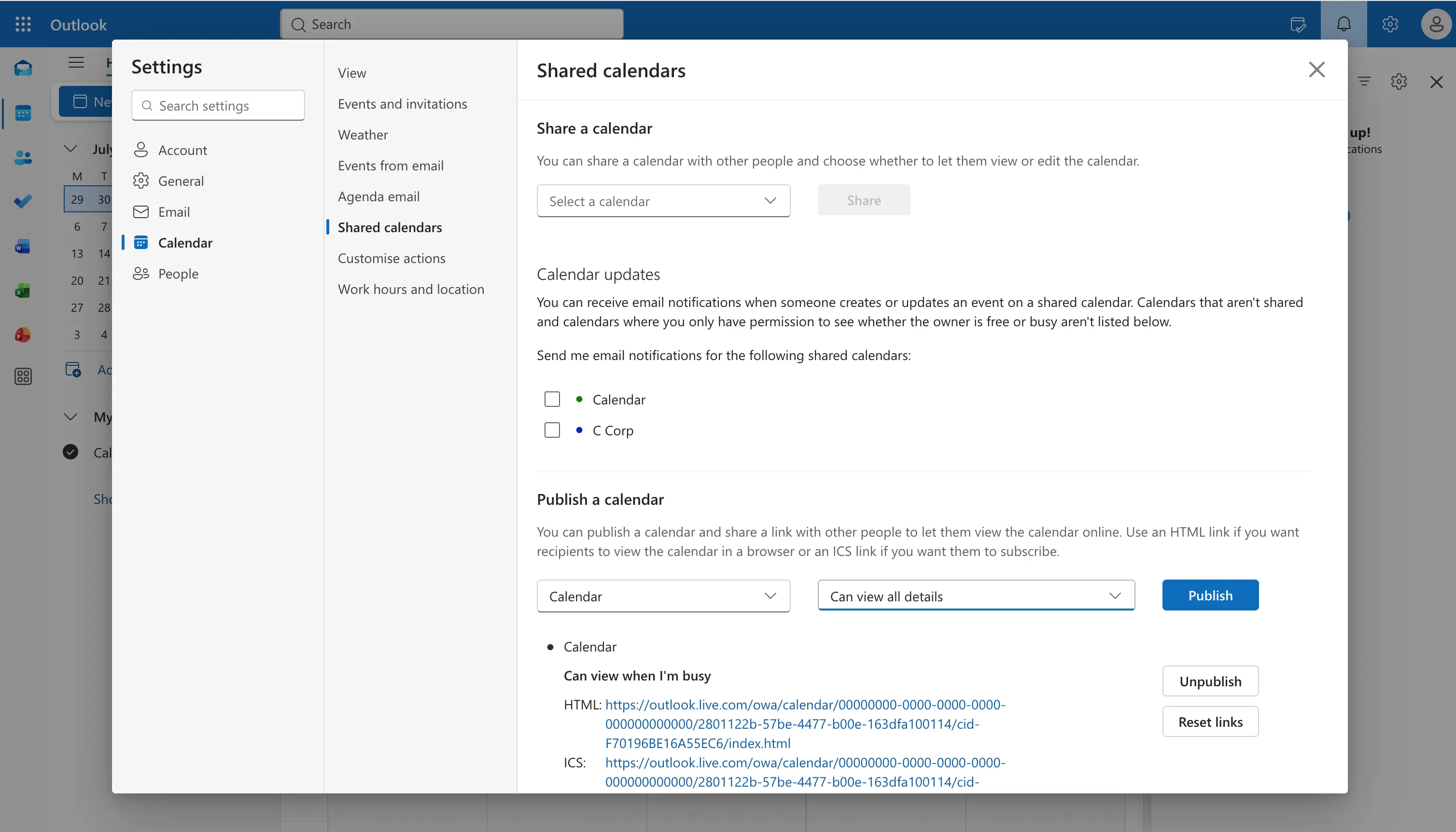
- Go to Settings in Outlook on the web.
- Open Calendar, then Shared calendars.
- Under Publish a calendar, choose the calendar and the level of detail, then click Publish.
- Copy the HTML link to let people view it in a browser, or the ICS link so they can subscribe to it in Google Calendar, Apple Calendar, or another app.
Anyone who has the published link can open your calendar, so only publish calendars that are meant to be seen by others. If you do not want to expose event details, publish only your free and busy availability.
How to create a shared calendar in Outlook
Sometimes you do not want to share your personal calendar. Instead you want a separate calendar that a whole team or family can use together. The cleaner way is to create a new calendar and share that one.
1. Create a new calendar
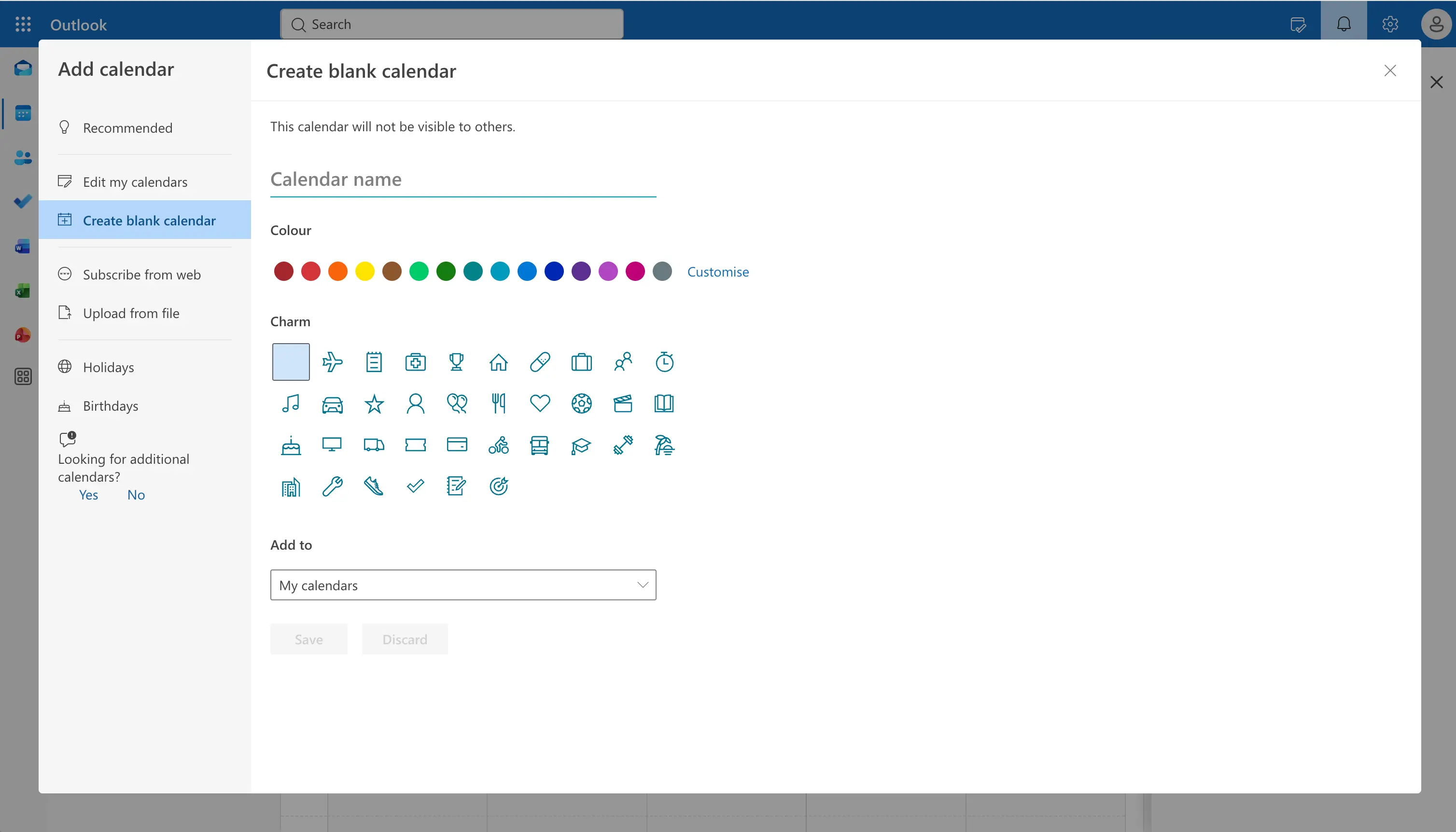
In Outlook on the web or new Outlook, click Add calendar in the calendar pane, then choose Create blank calendar. Give it a name, such as "Team Events" or "Family", and click Save.
2. Share the new calendar with your group
Open Sharing and permissions for the calendar you just created, add each person's email address, and choose Can edit so everyone can add and change events. Click Share.
This keeps the shared calendar separate from everyone's personal calendar. Each member can add events without exposing their own private schedule.
If your team uses Microsoft 365, you can also use a Microsoft 365 Group calendar. Every group has a shared calendar built in, and all members can see and add events to it automatically.
For a team calendar that needs to outlast any single person, ask your administrator to set up a shared mailbox or a resource calendar instead of sharing your personal one. The calendar then belongs to the organization, so access is not lost when someone leaves the company.
How to share an Outlook calendar from your phone
You can also share your calendar straight from the Outlook app on your phone. The steps are almost the same on iPhone and Android.
On iPhone
- Open the Outlook app and tap the Calendar icon at the bottom.
- Tap your profile picture or the menu in the top left corner.
- Tap the gear icon to open settings, then choose the calendar you want to share.
- Tap Add People, type the person's email address, and choose a permission level.
- Tap the checkmark or Add to send the invitation.
On Android
- Open the Outlook app and tap the Calendar icon at the bottom.
- Tap the menu in the top left corner, then tap the gear icon for settings.
- Select the calendar you want to share, then tap Add People.
- Enter the person's email address, choose a permission level, and confirm.
If you do not see these options on a work account, your company may have turned off sharing from mobile. In that case, set up sharing from a computer instead, or open outlook.com in your mobile browser and request the desktop version of the site.
How to open a calendar someone shared with you
If someone has shared their calendar with you, here is how to add it so you can see it next to your own.
- From an email invitation. Open the sharing email and click Accept or the button to add the calendar. It then appears in your calendar list.
- By adding it yourself. In Outlook, click Add calendar, choose Add from directory (on a work account) or Subscribe from web (for a published link), and enter the person's name or the calendar link.
Once added, the shared calendar shows up in your list, and you can tick or untick it to show or hide it next to your own calendar.
How to stop sharing an Outlook calendar
If you change your mind, you can remove someone's access in a few seconds.
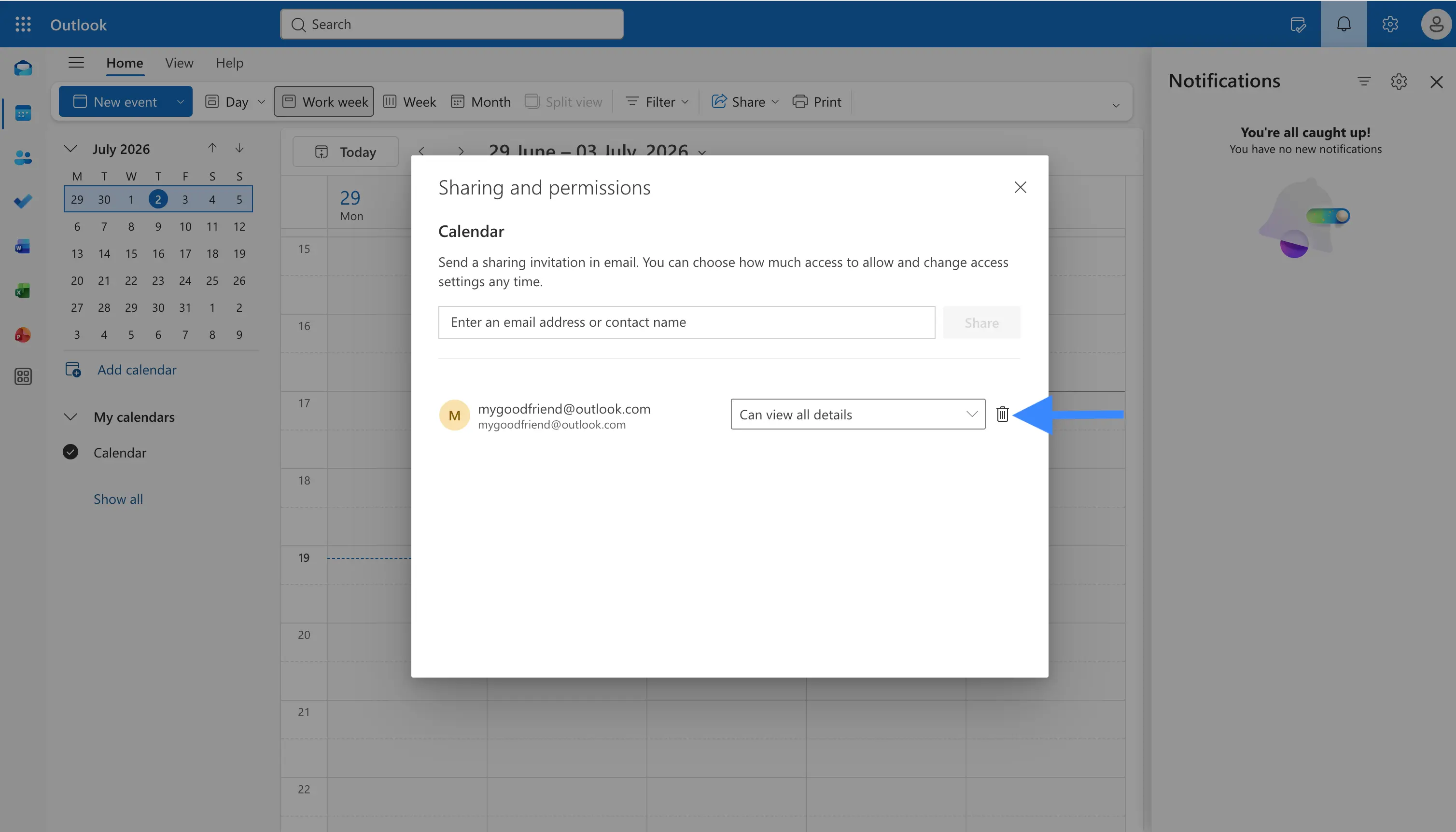
- Open Sharing and permissions for the calendar.
- Find the person in the list.
- Click the trash or Remove icon next to their name.
To stop a published calendar, go back to Settings, then Calendar, then Shared calendars, and click Unpublish under the published calendar. The change takes effect right away.
Troubleshooting: Outlook calendar sharing not working
If a shared calendar is not showing up, try these fixes.
- The invitation was not accepted. The other person needs to open the email invitation and click the button to add your calendar.
- External sharing is blocked. On work accounts, your admin may not allow sharing outside the company. Publish a link instead, or ask your admin.
- Wait a little. New shares can take a few minutes to appear. Refreshing or signing out and back in often helps.
- Check the account. Make sure the other person accepted the invitation while signed in to the correct account.
- Free and busy only. If they can see that you are busy but not the details, that is the permission level. Change it to Can view all details if you want them to see more.
Why a shared Outlook calendar is not always up to date
A shared Outlook calendar can look out of date to the person viewing it, and this catches a lot of people out. Sharing is not always real-time, and how fresh it is depends on the accounts involved.
- Same company (same Microsoft 365 tenant). When you and the other person are in the same organization, a shared calendar updates quickly, usually within a minute or two.
- Different companies or different account types. When you share across organizations, or between a work account and a personal account, updates can lag. It is common to see a delay of a few hours before a new event shows up for the other person.
- Published links and ICS feeds. A published calendar link refreshes even more slowly. The app the other person uses decides how often it checks for changes. Google Calendar can take a day or two to pick up new events from an ICS link, and other apps behave the same way.
There is also a second gap. When a coworker uses Scheduling Assistant or Find a time to book a meeting with you, Outlook looks at your own calendar, not always at calendars that were merely shared with you. So an event that lives only on a shared calendar may not block the time, and you can still get invited over it.
If you need other people, or your own second calendar, to always see your real availability, sharing is not enough on its own. Syncing copies your busy events onto the other calendar, so the times are always blocked and up to date. We explain how that works in the next section.
How to avoid double-booking when you share calendars
Sharing helps people see when you are busy, but it has a limit. When someone views your shared Outlook calendar, they can read your free and busy times, but those events do not block time on their own calendar. If you live in two calendars, such as a work account and a personal one, sharing alone will not stop a clash.
Here is the gap. You share your personal calendar with your work account so you can see both. A coworker then books a work meeting over a personal event. Because the personal event is only shared and not copied onto your work calendar, your work calendar still looks free, and you get double-booked.
To truly block time across both calendars, the events need to exist on both. That is calendar syncing, not sharing. A sync app copies your busy events from one calendar to the other, with the private details hidden if you want, so every calendar shows the same busy times and nothing can be booked over them.
This is exactly what a calendar syncing app like OneCal does. It clones events between your Outlook, Google, and iCloud calendars in real-time, so your availability is always correct on every calendar and you stop getting double-booked.
Frequently asked questions
How do I share my Outlook calendar with someone?
Open the Calendar in Outlook, open Sharing and permissions for the calendar you want to share, type the person's email address, choose a permission level, and click Share. They will get an email invitation to accept.
Can I share my Outlook calendar with someone outside my company?
Often yes, but it depends on your organization. If your Microsoft 365 administrator allows external sharing, you can share with any email address. If external sharing is blocked, publish your calendar as a link instead.
Does sharing my Outlook calendar sync it with another calendar?
No. Sharing only lets someone view or edit your calendar. It does not copy events onto a different calendar or account. To do that, you need a calendar sync app.
How do I create a shared calendar in Outlook?
Click Add calendar, choose Create blank calendar, give it a name, and save it. Then open Sharing and permissions for the new calendar and add the people you want, with the Can edit permission so they can contribute.
Can I control what other people see on my shared Outlook calendar?
Yes. Choose Can view when I'm busy to hide all details, Can view all details for read-only access to everything, or Can edit to let them make changes.
Sharing is not the same as having one unified calendar
Sharing is perfect when you simply want someone to see your schedule. But if your real goal is to have your events appear across several calendars or accounts, so your work and personal calendars block each other and you never get double-booked, sharing will not get you there.
That is a job for calendar syncing. Tools like OneCal clone events between your Outlook, Google, and iCloud calendars in real-time, so every calendar stays up to date automatically.
If you want to bridge Outlook with another account, or pull all your calendars into one view, read our guide on how to sync Google and Outlook calendars.